Press kit · updated October 6, 2026
Plai: Village Tale for press
A match-3 village builder set in Moldova, 1476, and made in Moldova. Everything on this page may be used freely in articles, videos and streams.
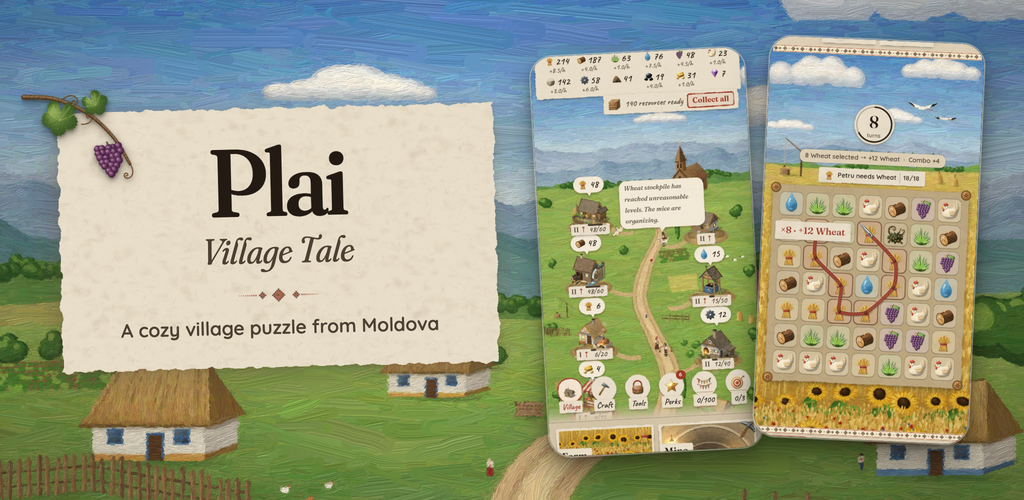
Key art, icon, feature graphic, twelve clean gameplay screenshots and the eight store screenshots, all as full-resolution PNG.
Factsheet
Description
Short
Plai: Village Tale is a cozy match-3 village builder set in 1476 Moldova. Match tiles to harvest crops and mine ore, then build, craft and grow a living village that follows the real seasons and keeps working while you're away.
Long
It is the year 1476, somewhere in the Moldovan countryside. A handful of settlers lay down their burdens in a clearing by a quick, clear stream — and the rest is up to you. Plai: Village Tale pairs a connect-chain match-3 puzzle with a living village economy: every wheat sheaf, water drop and lump of ore you match on the farm and mine boards flows home into storage, construction and crafting.
The village is a place, not a menu: villagers walk the road to work and stop to gossip, hens peck by the farm, storks circle overhead and smoke rises from every chimney. It keeps the real season and time of day — blossom in spring, golden leaves in autumn, snow on the roofs in winter, and lamps in the windows after dusk. It is also a real economy: thirteen buildings each upgrade through three tiers, workers are assigned by hand, storage fills in real time, and production keeps running for up to eight hours while the player is away. Between puzzle runs there are tools to forge and artisan recipes to craft, thirty-plus storybook events starring merchants, betting roosters and confrontational geese, daily bounties and streaks, a weekly harvest festival, and a prestige system that resets the village into a New Age with permanent bonuses.
The whole game is a love letter to Moldova. It looks like an old storybook — warm paper and ink, oil paintings of whitewashed cottages under thatch, embroidered borders, grapevines and wheat — and the puzzle chain is stitched across the board like embroidery thread. Villages carry real Moldovan names, and the villagers gossip like a crowd at the well. Built solo in Godot 4, fully localized in four languages, playable offline, and free — with nothing sold but optional rewarded ads.
Features
- Two connect-chain match-3 modes — sunny farm fields and lantern-lit mines — with golden tiles, wildcards, lightning chains, and creeping weeds and rocks to clear
- A living village map: villagers walking to work, animals, storks and chimney smoke, and a chronicle of village gossip
- The real seasons and the real time of day: blossom, golden leaves and snow through the year, lit windows and fireflies at night
- Fishing on the village river: 13 kinds of fish that bite by season and time of day, a fish book, odd finds, and a legendary old sturgeon in the deep
- A village garden: 13 decorations (flower beds, a carved bench, a vine arbor, a beehive and more) for 22 spots on the map, kept through every new age
- Five village pets, painted from the developer’s own family pets: tap one and it sits and says its name
- A village economy: 13 buildings × 3 upgrade tiers, manual worker assignment, per-building storage, and up to 8 hours of offline production
- A storybook opening in four painted chapters, then the village's name is the player's to choose
- 14 puzzle tools to forge and 11 artisan recipes to craft at the village smithy
- 36 storybook village events with trades, choices and gambles
- Daily bounties, a 7-day reward streak, daily gifts and supply crates
- A weekly village festival — the Harvest Hram — with milestone rewards
- Prestige system: raise the Manor to its peak and begin a New Age with permanent stars
- 24 achievements, from first harvest to legendary 10-tile chains
- Fully localized in English, Romanian, Russian and Ukrainian
- Free and offline-friendly: no account, no purchases — optional rewarded ads only
History
Plai began as a tiny browser prototype and was rebuilt from the ground up in Godot 4 by a single developer. The Moldovan identity came first — covor geometry, whitewashed cottages under thatch, grapevine pridvors — and the systems grew around it until the village felt inhabited: workers with opinions, festivals with themes, gossip with named villagers. The game launched on Google Play on July 13, 2026 and on the App Store on August 10, 2026. In October 2026 it was redrawn as a paper-and-ink storybook with oil-painted art, a living village map and the real seasons.
The full story, in the developer’s own words: The story behind Plai: Village Tale.
Screenshots
Clean gameplay captures with no marketing text. Click any image for the full-resolution PNG.


Store screenshots
The Google Play set, with captions (1080×1920 PNG). Click for full resolution.


Key art and logo


Videos, streams and monetization
You are welcome to publish and monetize videos, streams, screenshots and articles featuring Plai: Village Tale — no permission needed. A link back to plaivillage.com is appreciated. For interviews, review keys on future platforms, or anything not in this kit, write to dev.jdanov@gmail.com.
Credits
- Victor Jdanov — design, code, art direction
- Music by Kevin MacLeod (incompetech.com), CC BY 3.0
- Built with Godot Engine